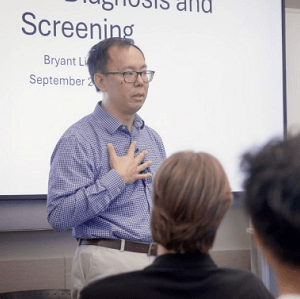
When Dr. Bryant Lin was diagnosed with stage IV lung cancer, he hadn’t smoked a single puff in his life. His diagnosis — a form of “never-smoker” lung cancer — is linked to a gene mutation that disproportionately affects people of Asian descent, especially women. Lin, a Taiwanese-American physician and educator at Stanford Medicine, turned his personal crisis into a powerful teaching moment.
He launched a course titled “From Diagnosis to Dialogue,” inviting students to witness his journey in real time. “In a way, this class is part of my letter — what I’m doing to give back to my community,” Lin told students. The course explores the full spectrum of cancer care, from mental health and spirituality to disparities in access and genetic predispositions.
Lung cancer remains the deadliest form of cancer worldwide, and its silent progression often leads to late diagnoses. “It doesn’t cause symptoms until it’s quite advanced,” said Dr. Natalie Lui, who leads Stanford’s lung cancer screening program. Lin’s own scans revealed cancer in his liver, bones, and 50 lesions on his brain.
Despite the grim prognosis, Lin’s story is one of resilience and advocacy. He co-founded Stanford’s Center for Asian Health Research and Education to address disparities like his own. “My dream is that you will go into cancer care,” he told students. “It would be great if even just one of you dedicated some part of your career to cancer.”
See: “A doctor, his cancer journey and a uniquely teachable moment” (October 16, 2024)