Maternal Mortality
Maternal mortality—the death of a woman during pregnancy or within one year after childbirth—is one of the starkest health disparities in the United States. The U.S. has the highest rate among developed nations.
Key Facts
- Black, Hispanic, and American Indian/Alaska Native mothers have the highest maternal mortality rates in the United States
- Most maternal deaths occur after delivery, often weeks or months later
- About 80% of maternal deaths are preventable
- Rates vary dramatically by state, with the highest rates in the South
Latest News on This Disparity
- States continue expanding 12-month postpartum Medicaid coverage (2025–2026)
- New investments target rural maternity care deserts
- Hospitals adopt maternal safety protocols to reduce preventable deaths
- Community-based doula programs expand in underserved areas
Who Is Most Affected
Maternal mortality disproportionately affects certain groups due to unequal exposure to risk, differences in care, and broader social inequities.
- American Indian and Alaska Native mothers die at a rate more than 8 times higher than White mothers
- Black mothers continue to die at a rate over 3 times higher than White mothers. This gap persists across all education and income levels.
- Asian mothers have a mortality rate 17% higher than White mothers.
- White mothers are 13% more likely to die than Hispanic mothers.
- Mothers living in rural areas in the US are about twice as likely to die as mothers living in large metropolitan areas.
Why This Is a Disparity
Maternal mortality is not evenly distributed among women in the United States. The differences persist across income and education levels, indicating that it’s a true health disparity driven by systemic—not biological—factors.
The Drivers Behind the Disparity
These factors compound. Maternal mortality disparities are the predictable result of systemic differences in care, risk, and lived conditions—not isolated factors.
1) Unequal Access to High-Quality Health care
Significance: Minority mothers are more likely to receive care in lower-resourced hospitals and to experience gaps in prenatal and postpartum care.
What helps: Expanding postpartum coverage, strengthening hospitals, and increasing access to midwives and doulas.
2) Differences in Quality of Care
Significance: Care varies across hospitals and providers, causing delays in recognizing complications, inconsistent protocols for treating problems, and poor coordination among staff.
What helps: Standardized safety protocols and quality improvement collaboratives.
3) Structural Racism and Bias
Significance: Bias affects how much symptoms are heard and treated by providers.
What helps: Bias training, workforce diversity, and culturally competent care.
4) Higher Burden of Chronic Conditions
Significance: Hypertension and cardiovascular disease, more common among some groups, increases the risk of complications.
What helps: Preventive care and early risk screening.
5) Social and Economic Conditions
Significance: Availability of adequate housing, income, food, and transportation affects a woman’s access to health care.
What helps: Social supports and improved care access logistics.
6) Geographic Inequities
Significance: Rural and tribal communities living in hospital and clinic deserts face limited access to care
What helps: Telehealth and rural maternity investment.
7) Postpartum and Mental Health Gaps
Significance: Half of maternal deaths occur months after delivery when health insurance coverage may have ended.
What helps: 12-month coverage and integrated mental health care.
8) Cumulative Stress called “Weathering.”
Chronic stress wears down resilience, increasing increasing long-term health risk.
What helps: Long-term community health investments.
Solutions
The United States leads high-income nations in maternal deaths—but most of these deaths don’t have to happen. An estimated 80 percent are preventable, pointing to clear opportunities for change. The strongest solutions target the root causes: gaps in continuous, high-quality care and the social and economic barriers that make it harder for some women to stay healthy. Reducing maternal mortality will require closing these gaps so that whether a woman survives childbirth in the U.S. is not dictated by race, income, or geography.
1) Expanding Access to Continuous, High-Quality Care
What’s working:
- Extending Medicaid coverage to 12 months postpartum
- Expanding access to midwives, doulas, and community-based providers
- Strengthening hospital capacity in underserved areas
Why it matters:
Continuous coverage and supportive care models improve early detection of complications and ensure follow-up after delivery.
Disparity Disruptor:
States that have extended postpartum Medicaid coverage are seeing improved care continuity, especially for low-income mothers.
2) Improving Quality and Safety of Maternal Care
What’s working:
- Standardized safety bundles for obstetric emergencies (e.g., hemorrhage, hypertension)
- Hospital quality improvement collaboratives
- Data tracking and accountability systems
Why it matters:
Consistent use of evidence-based protocols reduces preventable complications and deaths across hospitals.
Disparity Disruptor:
Statewide maternal safety collaboratives have reduced severe complications by standardizing care across diverse hospital systems.
3) Addressing Bias and Improving Patient-Centered Care
What’s working:
- Implicit bias and respectful care training
- Patient advocacy and navigation programs
- Diversifying the maternal health workforce
Why it matters:
Better communication and trust improve early recognition of symptoms and adherence to care.
Disparity Disruptor:
Community-based doula programs have been shown to improve outcomes and patient experience among Black and low-income mothers.
4) Managing Chronic Conditions Before and During Pregnancy
What’s working:
- Preconception care and early risk screening
- Integrated care models that coordinate obstetric and primary care
- Focused management of hypertension and cardiovascular risk
Why it matters:
Reducing underlying health risks before and during pregnancy lowers the likelihood of severe complications.
Disparity Disruptor:
Programs that integrate primary care with maternity services are improving outcomes for high-risk patients.
5) Addressing Social and Economic Barriers
What’s working:
- Transportation and care navigation support
- Group prenatal care models
- Policies addressing food, housing, and income stability
Why it matters:
Reducing logistical and financial barriers helps mothers access consistent, timely care.
Disparity Disruptor:
Group prenatal care models (e.g., CenteringPregnancy-style programs) have improved engagement and outcomes in underserved communities.
6) Expanding Care in Underserved and Rural Areas
What’s working:
- Telehealth for prenatal and postpartum visits
- Investment in rural maternity units and workforce
- Targeted support for tribal and frontier communities
Why it matters:
Access to care—especially in emergencies—depends heavily on geography.
Disparity Disruptor:
Telehealth expansion has improved access to specialists for rural and remote populations.
7) Strengthening Postpartum and Mental Health Care
What’s working:
- Extended postpartum coverage and follow-up care
- Screening for depression, anxiety, and substance use
- Integration of behavioral health into maternal care
Why it matters:
A significant share of maternal deaths occur after delivery, often linked to untreated mental health or medical conditions.
Disparity Disruptor:
Programs that embed mental health care into postpartum visits are increasing detection and treatment of high-risk conditions.
8) Investing in Long-Term Community Health
What’s working:
- Community health worker programs
- Long-term investments in neighborhood health and resources
- Cross-sector partnerships addressing structural inequities
Why it matters:
Maternal health outcomes are shaped long before pregnancy begins.
Disparity Disruptor:
Community-led health initiatives are helping reduce risk by addressing chronic stress and long-term health conditions.
Where Progress Is Happening
- California — Maternal safety collaboratives significantly reduced mortality rates
- North Carolina — Community health worker and care coordination models improving outcomes
- Multiple states nationwide — Adoption of 12-month postpartum Medicaid coverage
- Tribal health systems — Expanding culturally tailored maternal care programs
Final Bottom Line
Maternal mortality disparities are not inevitable—they are the predictable result of systemic gaps in care, access, and equity.
Because most maternal deaths are preventable, this disparity represents one of the clearest examples of avoidable harm in the U.S. healthcare system.
The challenge is not identifying solutions—it is scaling what works and ensuring it reaches those most at risk.
How These Solutions Fit Together
No single intervention is sufficient. The most effective approaches:
- Combine clinical improvements + social supports
- Focus on continuity of care before, during, and after pregnancy
- Target both healthcare systems and underlying inequities
Bottom Line
The evidence is clear:
Maternal mortality disparities are not inevitable—they are responsive to policy, healthcare system improvements, and community-based interventions.
The challenge is not identifying solutions.
It is scaling what works and ensuring it reaches the populations most at risk.
&&&&&&&&&&&&&&&&&&&&&&&&&&
Here are real, evidence-based examples of hospitals/health systems that implemented maternal safety bundles and reported measurable improvements. I’ve focused on concrete data you can cite in your disparity hub.
1. California hospitals (California Maternal Quality Care Collaborative)



Who
Statewide collaborative led by the California Maternal Quality Care Collaborative (CMQCC)
Included ~99 hospitals implementing the obstetric hemorrhage safety bundle
What they implemented
Standardized hemorrhage protocols (risk assessment, rapid response, drills)
Core elements aligned with maternal safety bundles (readiness, recognition, response, reporting)
Impact (strong, widely cited evidence)
20.8% reduction in severe maternal morbidity (SMM) among hemorrhage patients (PubMed)
Only 1.2% reduction in non-participating hospitals (comparison group) (PubMed)
11.7% reduction in SMM overall across all deliveries (ScienceDirect)
Why this matters
This is one of the strongest U.S. examples showing that bundle implementation at scale leads to measurable outcome improvements—not just process changes.
2. California Partnership for Maternal Safety (CPMS) hemorrhage collaborative
Who
Hospitals participating in the California Partnership for Maternal Safety, using CMQCC toolkits
What they implemented
Updated hemorrhage safety bundle + quality improvement collaborative model
Impact
20.8% reduction in severe maternal morbidity among hemorrhage cases (2014–2016)
Compared to only 1.2% reduction in non-participating hospitals (CMQCC)
Key takeaway
Reinforces that participation in structured bundle collaboratives—not just adoption—drives outcomes.
3. Ohio Hemorrhage Quality Improvement Project (multi-hospital initiative)

Who
Multiple hospitals across Ohio implementing the AIM Obstetric Hemorrhage Safety Bundle
What they implemented
Full bundle framework (the “5 Rs”):
Readiness
Recognition & prevention
Response
Reporting & systems learning
Respectful care (PMC)
Impact (data infrastructure + outcomes tracking)
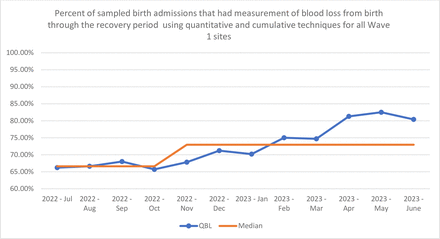
Hospitals collected and tracked:
Hemorrhage rates
Massive transfusions
Unplanned hysterectomies
Used dashboards and run charts to show improvement trends over time (BMJ Open Quality)
Key takeaway
Even when specific % reductions vary, this project shows:
Hospitals can operationalize bundles with real-time data
Measurement is central to sustained improvement
4. VCU Health (Virginia)
Who
Large academic health system in Virginia
What they implemented
Maternal safety bundles beginning in 2017, ahead of statewide mandate
Impact
While specific percentages aren’t publicly detailed, clinicians report:
Improved readiness for rare obstetric emergencies
More standardized, rapid responses to complications (VCU Health)
Key takeaway
Illustrates how early adopters influence statewide policy (Virginia later required bundles).
Big Picture (What these examples show)
Across these real-world implementations:
Maternal safety bundles are standardized, evidence-based protocols designed to reduce preventable deaths and complications (Maternal and Child Health Bureau)
The strongest evidence (California) shows ~20% reductions in severe maternal morbidity
Success depends on:
Team training and drills
Standardized protocols
Continuous data tracking
Participation in collaboratives
How you might use this on your site
For your “Disparity Disruptors / Solutions” section, this could be framed as:
Solution: Maternal safety bundles (AIM)
Proof point: California hospitals → ~20% reduction in severe maternal morbidity
Why it matters for disparities: Standardization reduces variation in care—a key driver of inequities
If you want, I can:
Find examples specifically reducing racial disparities (some bundles show larger gains for Black patients), or
Turn one of these into a “Spotlight” feature for your site with narrative + visuals.
